
How I understand the 12 Steps — without pretending to believe what I don’t
Why I’m writing this
When I first walked into meetings, I expected support. What I didn’t expect was how quickly sobriety would get tangled up with interpretation.
There were questions about how I worked the Steps. Questions about sponsorship. Questions about language I wasn’t fully comfortable adopting. I found myself wrestling not with sobriety, but with interpretation.
One uncomfortable moment still sticks with me: I overheard three AA members betting on when I would relapse. One guessed “next three months.” Another said sooner. Another said “30–60 days.” That’s when I got angry — not just at people, but at the feeling that I had nowhere to go.
And the part that really hit me was this: Was I not one who had a desire to not drink? Below is the Title, Tradition and 1st paragraph of Page 139 of The Big Book
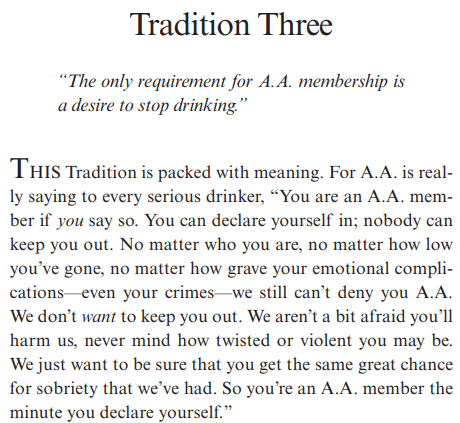
For a while I stepped away and tried SMART Recovery. The theory was strong, and I took tools from it. But the structure felt too loose for me. What I did miss was the fellowship of AA — the simple fact of showing up with other people who understand the battle. Yes, SMART Recovery offers meetings, but not at the frequency and variety of AA, which is important.
So I went back. I found rooms where the group conscience — for the most part — actually practiced inclusiveness instead of gatekeeping. I reevaluated my stance, and I worked through each Step on my own, carefully and honestly, using what helped and refusing to fake what I didn’t believe.
This isn’t a dismantling of AA. I don’t disparage the program. I respect that AA works for many people.
What I’m documenting here is simpler than that:
- I don’t want to argue anyone out of their path.
- I don’t want to be a reason someone doesn’t try AA.
- I do want people to know it’s possible to stay sober without being forced into one interpretation of recovery.
This is how I understand the Steps — in a way that stays honest for me, protects integrity, and keeps sobriety as the goal.
And according to myself and supported by the above referenced page, I AM a grateful member of Alcoholics Anonymous!
Step 1
“We admitted we were powerless over alcohol — that our lives had become unmanageable.”
For me, admitting there is a problem is powerful — and necessary. If I don’t acknowledge the problem, I can’t address it. That part is real.
Where I diverge is the word powerless, because I define it literally. In most cases, I believe choice and agency still exist, even when the pull is strong. I don’t deny that capacity can be reduced in extreme circumstances — and in those cases, medical intervention may be more appropriate than peer-language about surrender. But as my personal framework, I don’t live in a permanent identity of powerlessness.
I understand the value of the concept for others. If “powerless” is the language that helps someone remove denial, lower ego, and stop picking up, I respect that. I’m not here to take it away from anyone.
For me, sobriety came through recognizing the cost, regaining discipline, and choosing not to roll the dice. I’m not powerless over alcohol — I’m stronger than it when I stay awake to what it costs me. That’s my truth, and I won’t pretend otherwise just to fit in.
Step 2
“Came to believe that a Power greater than ourselves could restore us to sanity.”
My immediate reaction to Step 2 is that it can feel exclusionary — especially when “Power” gets automatically translated into “God” in practice.
I also recognize that “Power greater than ourselves” doesn’t have to mean supernatural. It can mean reality, consequences, truth, community, nature, time, principles, or simply stepping outside my own impulses. I understand the humility embedded here: my solo thinking failed me; I need something outside my impulses to reference.
Where I diverge is the idea that recovery should require a belief in “something” beyond admitting the problem and choosing change. For me, the only “something” that has to be believed is this: I’m drinking too much and I need to change. Without that, nothing else matters.
“Restore to sanity” also reads like 1939 vernacular to me — more like people saying “that’s crazy” today than a clinical diagnosis. I don’t view myself as insane, and I don’t treat this Step as a medical claim.
My interpretation is simple: Step 2 points to the need for humility and a stabilizing reference point beyond impulse — but it should not be used as a gatekeeping requirement or a forced belief system.
Step 3
“Made a decision to turn our will and our lives over to the care of God as we understood Him.”
Step 3 is where the tension becomes sharper for me: Step 2 says “Power as we understood it,” and Step 3 shifts into “God” and “Him.” In 1939, “God” meant God for most people — and that framing still carries weight today.
I understand what the Step is aiming at: letting go of the illusion that I can control everything, and releasing the obsessive grip that keeps me trapped. I get the theory.
But for me, my will is mine. I don’t experience sobriety as giving my will away — I experience it as reclaiming it. I’m not comfortable adopting language that implies I must hand my agency to something external as a requirement for recovery.
If someone draws strength from God or a Higher Power and it helps them stay sober, I respect that path. For me, the “turning over” is better understood as turning away from impulse and toward values, discipline, and sober judgment — without pretending belief I don’t have.
Step 4
“Made a searching and fearless moral inventory of ourselves.”
This Step makes sense to me, and I see it as foundational — not as punishment, but as clarity.
I don’t have an issue with the word “moral” itself. My issue is when one person tries to impose their morality on someone else beyond basic human decency. A 1939 moral framework isn’t the modern world — and it shouldn’t be wielded like a weapon.
For me, Step 4 is about honest self-review: patterns, blind spots, reactions, ego, resentment, fear, avoidance, harm done, harm received, and where I’m still lying to myself. It’s not about perfection. It’s about accuracy.
Step 5
“Admitted to God, to ourselves, and to another human being the exact nature of our wrongs.”
This is where I get very careful.
I fully agree with the value of honesty and confronting self-deception. I agree that isolation can distort reality. I understand why speaking things aloud can break shame cycles for some people.
But for me: exposure without protection is not growth — it is risk.
That’s my position. Others may feel differently.
I do not believe I must confess the “exact nature of my wrongs” to another person as a requirement. I can admit truth to myself. I can write it. I can process it. And if I share it, I choose how, when, and with whom.
If someone wants full disclosure with a sponsor, clergy, or trusted person and it helps them, I respect that. For me, the safest container for deep disclosure is a licensed therapist (or attorney when relevant), because there is accountability and privilege. I won’t treat sponsorship like confession or absolution.
Step 6
“Were entirely ready to have God remove all these defects of character.”
My focus here is not “God removing defects.” My focus is readiness to change.
I can accept “defects of character” as plain language for patterns that cause harm: ego, impatience, resentment, dishonesty, avoidance, anger, impulsivity, judgment — whatever applies. I also see how the Serenity Prayer fits here: recognizing what I can change, what I can’t, and the wisdom to know the difference.
Where I diverge is the framing that an external agent removes defects. For me, this Step is about becoming genuinely ready to do the work — not outsourcing responsibility.
Step 7
“Humbly asked Him to remove our shortcomings.”
To me, Steps 6 and 7 are essentially one movement: readiness and action. Identify the issue, commit to working on it, and keep working.
I understand humility as an attitude: I’m not above correction, and I’m not done growing. I don’t treat humility as kneeling to a deity I don’t believe in.
So my interpretation is: commit humbly to actively working on the shortcomings identified.
If someone asks God for help and that’s what works for them, fine. For me, the “asking” is a commitment to action, repetition, and correction — not a supernatural transaction.
Step 8
“Made a list of all persons we had harmed, and became willing to make amends to them all.”
This Step is difficult for me in practice, not because I don’t value repair, but because life is complex.
I can’t catalog every unintended wound — intended or unintended. I’m 57. I’ve lived in many places. I’ve harmed people I don’t even remember, and people may have been harmed without me even realizing it.
I also struggle with the way “amends” can be used like absolution. Saying “sorry” doesn’t erase impact. And sometimes making contact can do more harm than good.
For me, accountability is real — but it shows up in changed behavior, restored trust, and how I treat people now. Where direct repair is appropriate and safe, I’m willing. Where it’s impractical, harmful, or self-serving, I believe the better amends is sustained change.
Let the past be a compass — not an anchor.
Step 9
“Made direct amends to such people wherever possible, except when to do so would injure them or others.”
I interpret Step 9 as the practical extension of Step 8 — not a separate category in my mind.
My governing filter is not a single sentence, because real life isn’t that clean. But the core questions I use are:
- Does this repair more than it harms?
- Am I doing this to help them — or to relieve myself?
- Will this create new damage I can’t undo?
Sometimes the most ethical “amends” is not re-opening a wound for someone else just so I can feel clean. And sometimes direct amends are absolutely right. I treat it case-by-case, grounded in impact — not ritual.
Step 10
“Continued to take personal inventory and when we were wrong promptly admitted it.”
This Step aligns with how I already live when I’m at my best: stay aware, stay honest, adjust quickly.
I don’t see this as religious. I see it as maintenance. The moment I stop checking myself, I drift. When I’m wrong, I admit it. When I damage something, I repair it as best I can.
Step 11
“Sought through prayer and meditation to improve our conscious contact with God as we understood Him, praying only for knowledge of His will for us and the power to carry that out.”
I value the function of this Step: reflection, grounding, awareness, correction, and steadying the mind.
The religious language is where it becomes less inclusive for me. I don’t look for a “replacement” for God. I look for redirection: practices that produce clarity, humility, and restraint.
For me this becomes: meditation (when I can), reflection, gratitude, and deliberate course-correction — improving conscious contact with reality, values, and consequences, and building the ability to carry out the choices that keep me sober.
Step 12
“Having had a spiritual awakening as the result of these steps, we tried to carry this message to alcoholics, and to practice these principles in all our affairs.”
The wording “Having had” is off-putting to me because it assumes a universal experience — and it can create a silent failure-state: If I didn’t have a “spiritual awakening,” did I fail?
I don’t deny that rock bottom or spiritual awakening can happen. I deny that either is universal, required, or predictable — and I’ve seen people weaponize those expectations.
For me, the “awakening” is measurable change: integrity, stability, clearer thinking, better responses, fewer self-inflicted fires, more presence, less escape.
I don’t feel a need to advertise or project. But I do believe in being available — especially to people who feel pushed out because they don’t fit a narrow interpretation. I want them to know they’re not broken because they think differently. The goal is sobriety. The path may vary.
Closing
AA works for many people. It has helped millions. I am not here to fight it, dilute it, or stand outside it criticizing it.
I am a member of Alcoholics Anonymous for one reason:
I have a desire to stop drinking.
That is not my interpretation. That is not my workaround. That is not my negotiation.
Bill W. wrote in a 1958 Grapevine article:
“Who is to say who belongs in A.A. and who does not? A.A. is not a court of law.”
I meet the only requirement.
Not because I interpret every Step the same way as someone else.
Not because I use identical language.
Not because I structure sponsorship the same way.
But because I do not want to drink.
If someone believes membership requires more than that, they are free to believe it.
But AA itself does not.
I respect the program. I respect the fellowship. I respect the people it has saved.
What I will not do is pretend to believe something I do not believe in order to belong.
Sobriety is the goal.
Integrity matters too.
Stay sober.
Keep growing.
And remember what actually qualifies you to be here.
 Tides and Truth...